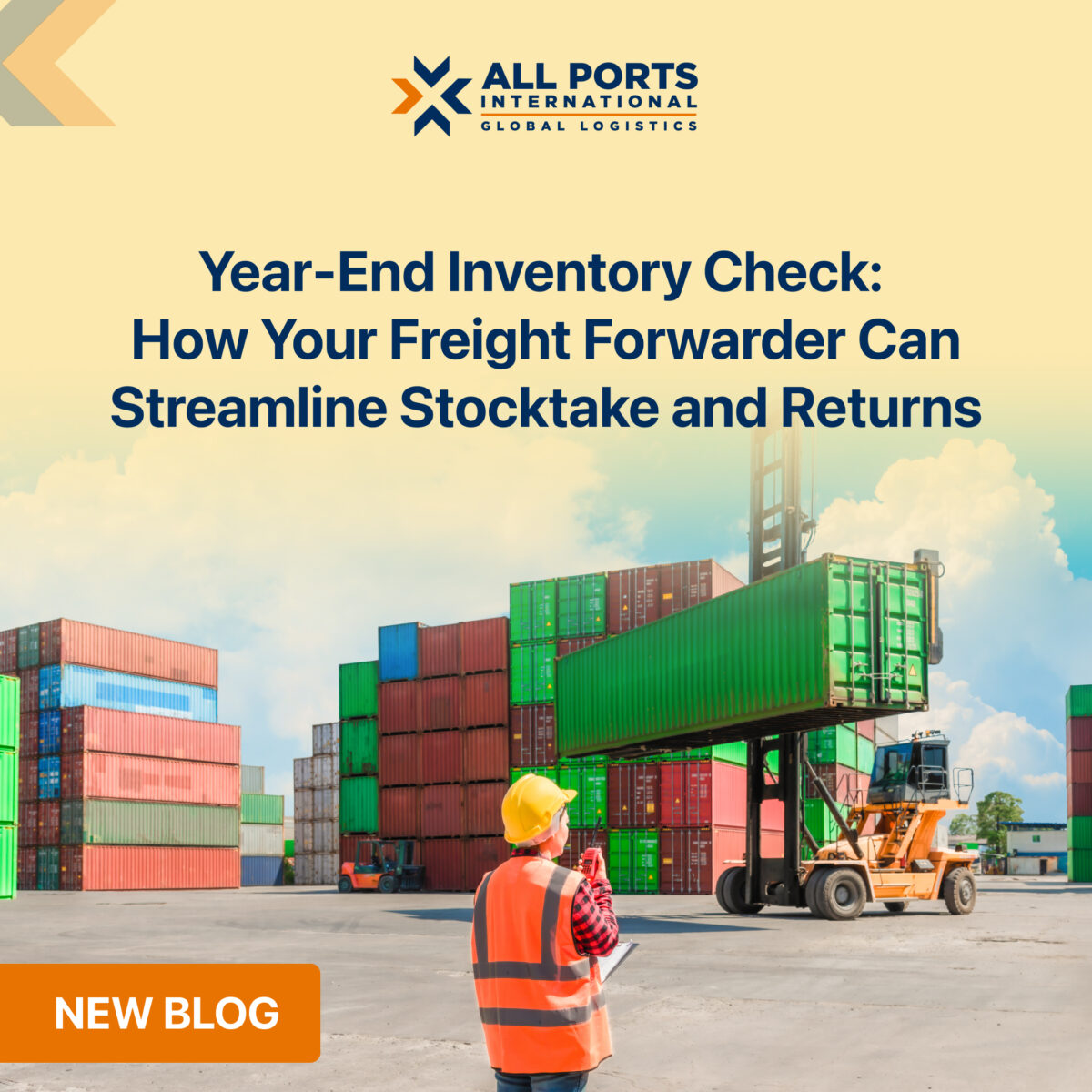
Year-End Inventory Check: How Your Freight Forwarder Can Streamline Stocktake and Returns

The final weeks of the year are usually consumed by the "December Dash" to get last-minute holiday stock delivered. But once the rush is over, every business faces the less glamorous but essential task of the year-end inventory check.

This process involves more than just counting stock—it’s about managing unsold goods, handling returns, and repositioning equipment. These non-standard logistics challenges can be complex, requiring flexibility and attention to detail. This is where All Ports International’s comprehensive logistics capabilities and personalised service truly make a difference.

While our primary focus is international logistics and customs brokerage, our role as your freight forwarder extends to providing support for the essential "housekeeping" tasks that impact your bottom line:

Managing Unsold or Aged Stock

If you're left with surplus inventory that needs to be moved, stored, or re-exported, the logistics differ greatly from standard imports.

  • Repositioning: We can coordinate transport from your primary warehouse to a secondary storage facility or a new market, ensuring smooth interstate and international movement.
  • Documentation: For goods being re-exported or moved across borders, the paperwork and customs procedures require specific handling to avoid unnecessary duties or penalties.

Streamlining Returns and Reverse Logistics

The post-holiday period inevitably brings returns. Handling this "reverse logistics" efficiently is vital for customer satisfaction and your cash flow.

  • Coordinated Movement: We can help manage the shipment of returns from a customer back to your warehouse, or from your warehouse back to the supplier overseas.
  • Problem-Solving: If a large shipment of goods needs to be inspected or repackaged before being returned, we use our network and expertise to coordinate these steps.

Handling and Repositioning Unique Cargo

For clients who deal with special or large equipment (like the German-engineered car stacker we handled), the end of a project often means equipment needs to be moved, stored, or shipped to a new site.

This process requires coordination of specialised trucking, potential customs re-entry planning, and the precise timing to prevent delays.

Dealing with these non-standard, year-end logistics can often be frustrating when working with large, impersonal carriers. Here’s how All Ports International is different.

  • Flexibility and Friendliness: Our clients love our friendliness and dedicated, long term staff. This means you are dealing with a partner who is flexible and willing to put in the effort to find solutions for your unique year-end needs, not just process another container.
  • Clear Communication: For complex tasks like reverse logistics or specialised movements, clear communications  are paramount. We keep you informed at every stage, so you know exactly where your assets and inventory stand.

Your year-end checklist should include a dedicated, reliable logistics partner. Let us handle the intricate details of your stock take, returns, and repositioning so you can focus on starting the new year strong.

Need a flexible and friendly logistics plan for the end of the year? Contact the team at All Ports International today.

The December Dash: How to Mitigate Risk and Avoid Holiday Season Shipping Chaos

For many businesses, December is a crucial month. It's the final push to meet peak holiday season demand and wrap up shipments before the New Year. This rush, however, turns the international logistics landscape into a chaotic "December Dash," a period where the normal complexities of shipping are magnified.

The pressure to deliver can lead to last-minute decisions and frantic coordination, which is often when "spot fires" caused by 3rd party service providers ignite. At All Ports International, we focus on proactive strategy and transparent communication to help you navigate this high-risk period seamlessly.

1. Port and Carrier Congestion

As importers around the globe rush to replenish stock, demand for shipping space skyrockets. This leads to:

  • Vessel Delays: Ships are overbooked, leading to increased pressure on sailing schedules and a higher chance of delayed vessel departures.
  • Port Bottlenecks: Congested ports mean extended waiting times, which can quickly disrupt your planned timeline and cause costly delays.

2. The Rise of "Spot Fires"

When pressure is high, the margin for error shrinks. A small misstep by an uncoordinated third-party provider can quickly derail your entire shipment. These are the "spot fires" we find ourselves solving most often.

3. Unexpected Price Surges

The intense demand during this season gives carriers the leverage to apply Peak Season Surcharges (PSS) and unexpected rate increases with little notice, turning your predictable shipping budget into a guessing game.

Avoiding the chaos of the December Dash comes down to choosing a partner dedicated to foresight and diligence. End to end service  is your best defence against holiday season turmoil. 

  • Book Space Early: We help you book space on ships far in advance, insulating your cargo from the last-minute capacity crunch and reducing the risk of being rolled to a later vessel.
  • Clear Communication: Communication is key. We ensure you are informed every step of the way, giving you the visibility needed to plan your downstream operations and internal deadlines without delay.
  • Proactive Monitoring: We actively monitor the vessel departure and arrival  of your cargo. This proactive approach allows us to anticipate and troubleshoot potential delays before they escalate into major problems that cost you time and money.

Don't let the rush of the December Dash compromise your supply chain. We handle the complexities of international logistics and customs brokerage  so you can enjoy a smooth transition into the New Year.

Ready to secure your final shipments of the year? Contact us today for a proactive, stress-free shipping experience.

The Asia-Pacific Corridor: Navigating the Unique Logistics Challenges of Importing from Key Markets

The Asia-Pacific Corridor_ Navigating the Unique Logistics Challenges of Importing from Key Markets

The Asia-Pacific region, home to some of the world's largest manufacturing hubs, is the engine room of global supply chains. For businesses importing from countries like China, Vietnam, and Indonesia, the opportunities are immense. However, this high-volume corridor also presents a unique set of logistics challenges.

At All Ports International, we service all overseas destinations and specialise in demystifying these complexities. Our market expertise and customer service ensure your cargo moves efficiently, even through the busiest trade lanes.

Peak Season Pressure and Port Congestion

The Asia-Pacific trade lane experiences predictable periods of extreme volume that can cause major headaches:

  • Lunar New Year: This is a key period where factory closures halt production for weeks, creating a surge of pre-holiday shipments and a backlog immediately following the holiday. Booking space on ships and coordinating vessel departure and arrival becomes critical during this time.
  • Peak Shipping Season: Typically running from late summer through early winter, this period sees carriers imposing Peak Season Surcharges (PSS) and ports struggling with congestion, which can lead to extended waiting times and operational delays.

The All Ports Solution: We actively monitor these cycles and prioritise clear, advanced communication. By being proactive and securing space well ahead of time, we work to prevent unexpected delays that disrupt your operations.
Documentation Nuances and Compliance

Every country has its own distinct customs regulations and required paperwork, and even minor errors can lead to costly "spot fires" and lengthy delays at customs.

  • Customs Brokerage Complexity: Importing from multiple countries in the region means dealing with varying tariffs, documentation requirements, and local customs compliance laws.
  • HS Code Accuracy: An incorrect Harmonised System (HS) code classification can result in wrong duty payments or trigger customs inspections.
The All Ports Solution: Our long-term staff are experts in customs brokerage. We ensure all documentation is handled correctly from the outset, including the preparation and submission of all necessary paperwork, providing you with a seamless and compliant import process.

Navigating Freight Market Volatility

The high-volume nature of this corridor makes it extremely sensitive to market changes, which is where many of the variable surcharges originate:

  • Fuel and Currency: Carriers frequently apply BAF (Bunker Adjustment Factor) to cover fuel cost fluctuations, and CAF (Currency Adjustment Factor) to hedge against exchange rate volatility. These can make budgeting difficult.
  • Capacity and Rates: Rates can surge rapidly due to sudden demand or capacity shortages, particularly when carriers are forced to reposition empty containers (leading to a Container Imbalance Charge, or CIC).

The All Ports Solution: We provide transparent pricing and act as your knowledgeable guide through the costs, explaining fees upfront. By being your dedicated partner, we manage the complex relationship with multiple third-party service providers, solving those spot fires before they impact your business.

Don't let the complexity of the Asia-Pacific trade lane be a barrier to your growth. As specialists in International Freight Forwarding and Logistics, All Ports International provides the expert knowledge and personal attention you need to secure your cargo's smooth journey.

Ready to simplify your supply chain in the world’s busiest corridor? Contact us today to discuss your next shipment.

Ocean Freight Surcharges: Demystifying BAF, CAF, and Other Fees That Impact Your Bottom Line

If you import goods, you know the frustration: you receive an ocean freight quote, and alongside the base rate, you see a seemingly endless list of surcharges, each represented by a confusing three-letter acronym. These additional fees can significantly impact your total landed cost and often feel unpredictable.

At All Ports International, we believe in providing clear, transparent pricing. We understand that cost uncertainty is a major client pain point, which is why we’re demystifying some of the most common ocean freight surcharges to help you budget smarter and avoid hidden costs.

The Big Two_ BAF and CAF

These are the two most frequently seen and misunderstood surcharges, both used by shipping carriers to protect themselves against fluctuating operational costs.

BAF (Bunker Adjustment Factor)

  • What it is: BAF is a variable surcharge applied to compensate for global oil price fluctuations. The term "bunker" refers to the fuel used to operate the ships.
  • Why it's Charged: Fuel prices are one of the largest and most volatile components of shipping costs. BAF acts as a safeguard for carriers against sudden increases in the price of bunker fuel.
  • How it Works: BAF surcharges are generally calculated and issued each month or every quarter, rising when fuel prices soar and decreasing when they drop.

CAF (Currency Adjustment Factor)

  • What it is: CAF is a surcharge applied to mitigate losses or gains due to fluctuations in global currency exchange rates.
  • Why it's Charged: Freight rates are often quoted in U.S. dollars, but carriers incur operating costs (like port fees and labor) in various local currencies. If the billing currency (e.g., USD) weakens relative to the cost currencies, the carrier loses revenue.

How it Works: CAF is typically quoted as a percentage of the base ocean freight rate and is adjusted periodically to reflect market changes.

Other Common Surcharges You Need to Know

These are the two most frequently seen and misunderstood surcharges, both used by shipping carriers to protect themselves against fluctuating operational costs.

BAF (Bunker Adjustment Factor)

  • What it is: BAF is a variable surcharge applied to compensate for global oil price fluctuations. The term "bunker" refers to the fuel used to operate the ships.
  • Why it's Charged: Fuel prices are one of the largest and most volatile components of shipping costs. BAF acts as a safeguard for carriers against sudden increases in the price of bunker fuel.
  • How it Works: BAF surcharges are generally calculated and issued each month or every quarter, rising when fuel prices soar and decreasing when they drop.

CAF (Currency Adjustment Factor)

  • What it is: CAF is a surcharge applied to mitigate losses or gains due to fluctuations in global currency exchange rates.
  • Why it's Charged: Freight rates are often quoted in U.S. dollars, but carriers incur operating costs (like port fees and labor) in various local currencies. If the billing currency (e.g., USD) weakens relative to the cost currencies, the carrier loses revenue.

How it Works: CAF is typically quoted as a percentage of the base ocean freight rate and is adjusted periodically to reflect market changes.

These are the two most frequently seen and misunderstood surcharges, both used by shipping carriers to protect themselves against fluctuating operational costs.

BAF (Bunker Adjustment Factor)

  • What it is: BAF is a variable surcharge applied to compensate for global oil price fluctuations. The term "bunker" refers to the fuel used to operate the ships.
  • Why it's Charged: Fuel prices are one of the largest and most volatile components of shipping costs. BAF acts as a safeguard for carriers against sudden increases in the price of bunker fuel.
  • How it Works: BAF surcharges are generally calculated and issued each month or every quarter, rising when fuel prices soar and decreasing when they drop.

CAF (Currency Adjustment Factor)

  • What it is: CAF is a surcharge applied to mitigate losses or gains due to fluctuations in global currency exchange rates.
  • Why it's Charged: Freight rates are often quoted in U.S. dollars, but carriers incur operating costs (like port fees and labor) in various local currencies. If the billing currency (e.g., USD) weakens relative to the cost currencies, the carrier loses revenue.

How it Works: CAF is typically quoted as a percentage of the base ocean freight rate and is adjusted periodically to reflect market changes.

Incoterms Simplified: A Beginner’s Guide for Smart Importing and Exporting

Navigating international shipping can be a complex undertaking, filled with intricate rules and responsibilities. At the heart of it all are Incoterms®, a set of globally recognised rules that act as the rulebook for buyers and sellers, defining who is responsible for what at each stage of a shipment.

Understanding Incoterms is essential because they clarify a crucial question: where does the responsibility—and risk—of the goods transfer from the seller to the buyer? Choosing the wrong term can lead to unexpected costs, delays, and even legal disputes.

Incoterms, or International Commercial Terms, are published by the International Chamber of Commerce (ICC) and are updated periodically to reflect changes in global trade. They are a three-letter acronym followed by a named place, such as FOB (Free On Board) Port of Los Angeles. This named place is critical because it's the point where costs and risks transfer from the seller to the buyer.

While there are 11 Incoterms, a few are used most frequently in international trade. Knowing these will give you a solid foundation.

  • EXW (Ex Works): The seller's responsibility ends as soon as the goods are made available at their premises. The buyer assumes all costs and risks from that point forward, including export clearance. This places the maximum responsibility on the buyer.
  • FOB (Free On Board): The seller is responsible for the goods until they are loaded on board the vessel at the named port. The buyer then assumes all responsibility and costs from that point.
  • CIF (Cost, Insurance and Freight): The seller pays for the carriage and insurance to the named port of destination. However, the risk transfers to the buyer once the goods are on board the vessel at the port of shipment. This is a key distinction: risk and costs transfer at different points.
  • DDP (Delivered Duty Paid): This places the maximum responsibility on the seller. The seller is responsible for all costs and risks, including customs clearance and import duties, until the goods are delivered to the buyer's specified location.

Choosing the wrong Incoterm or misinterpreting its rules can lead to serious consequences. Here are some of the most common mistakes and how All Ports International helps you avoid them:

  • Confusing Cost with Risk: Many people mistakenly believe that the party paying for the freight also bears the risk, which isn't always true. We can guide you to a complete understanding of where risk transfers, protecting you from unexpected losses.
  • Lack of Clarity in the Contract: Not specifying the named place in the Incoterm can lead to disputes and delays. We work with you to ensure all details are precise and clearly documented, leaving no room for ambiguity.

Navigating the complexities of Incoterms is a prime example of how good old fashioned customer service and expert knowledge are essential in international logistics. At All Ports International, we handle the intricacies of these rules so you can focus on your business, confident that your shipments are in expert hands.

Ready to simplify your international trade? Contact the team at All Ports International today for a seamless, stress-free import process.

How to Extinguish Logistics Fires and Prevent Them in Your Supply Chain

How to Extinguish Logistics Fires and Prevent Them in Your Supply Chain

In the fast-paced world of international logistics, everything needs to move with precision and speed. But what happens when a shipment gets stuck, communication breaks down, or an unexpected issue derails your plans? These are what we call "spot fires"—and they're all too common in the supply chain.

At All Ports International, we frequently find ourselves solving these kinds of issues. Often, these problems are caused by missteps or miscommunication from 3rd party service providers. When you're managing a complex supply chain, a single unexpected delay can cause a domino effect, leading to missed deadlines, unhappy customers, and a lot of unnecessary stress.

So, how can you spot these "fires" before they start and ensure a smooth journey for your cargo?

Many supply chain "spot fires" ignite because of a lack of clear and timely communication. A provider might not have informed you about a critical delay, or perhaps they’ve failed to provide accurate tracking information. This is where All Ports International’s commitment to excellent communication and customer service comes into play. We believe in keeping you informed every step of the way, so you never have to chase down information.

Working with a faceless third-party provider can be a recipe for disaster. When something goes wrong, you want a partner who is invested in your success. Our long-term staff and dedication to customer service means we treat your cargo with the same care and attention as if it were our own. Our friendliness and personal approach ensure that we are always there to help put out any "fires" that may arise.

Waiting for a problem to happen is not a strategy. A great logistics partner proactively monitors your shipment and anticipates potential issues before they can escalate. By booking space on ships and monitoring vessel departure and arrival, we are able to stay ahead of the curve and ensure your plans aren't delayed. When a challenge does arise, we act quickly to find a solution, allowing you to plan your own operations without delay.

In the end, you shouldn't have to spend your valuable time putting out "spot fires" in your supply chain. You should have a partner who is dedicated to preventing them from ever starting.

Ready to experience a smoother, more reliable supply chain? Get in touch with the team at All Ports International today. We're here to help you move your goods—and your business—forward.