Inland Freight Solutions: Connecting the Dots Between Port and Warehouse

The journey of your imported cargo doesn't end when the ship docks. In fact, what happens after the vessel arrives—the inland movement from the wharf to your warehouse—is often the most critical and complex part of the process, commonly known as the "final mile" (or the first mile, if you are exporting).

At All Ports International, we understand that seamless International Logistics requires expert management of every link, especially the road and rail connections known as pre-carriage and on-carriage.

Once your container is discharged from the vessel, it enters a critical phase where costs and risks can escalate rapidly if coordination fails:

  • Port Congestion and Demurrage: Delays in organising transport mean your container sits at the wharf, quickly incurring demurrage (charges levied by the shipping line for extended use of the container) and storage fees (charges levied by the terminal). These fees can turn a profitable shipment into a loss-maker.
  • Trucking Shortages: During peak season or times of high port congestion, securing a truck and a slot for pickup can be a major challenge. Relying on an outside, unvetted provider often leads to last-minute cancellations and missed deadlines.

Third Party Service Providers: The most common challenge we solve is when a 3rd party service provider—a trucking company, an external depot, or a rail operator—fails to execute their task.

Our core strength lies in managing your entire shipment journey, from booking space on ships to coordinating delivery to your door. We ensure the transition between sea and land is flawless.

1. Expert Coordination: Managing Pre-Carriage

Pre-carriage refers to the transport of export cargo from your warehouse to the terminal at the port of loading.

We manage the scheduling and booking of the container and truck to your facility. Our process ensures the cargo is delivered to the wharf in time to meet the vessel's cut-off, preventing costly roll-overs to the next available sailing.

2. Proactive Control: Mastering On-Carriage

On-carriage is the movement of import cargo from the destination port to your final warehouse. This is where most errors occur.

  • Timing and Monitoring: We prioritise clear communication and proactive monitoring. Our team tracks the vessel's arrival, coordinates with customs to ensure swift clearance (avoiding costly delays), and pre-books the trucking slot needed to avoid terminal congestion.
  • Vetted Networks: We rely on established networks of trusted road and rail partners. This control prevents the unpredictable issues that arise from using unreliable third-party providers.

By integrating the inland journey seamlessly with the international voyage, we ensure a smooth transition from the wharf to your destination, saving clients time and preventing delays.

You shouldn't have to worry about whether a last-mile trucking company will show up. That's our job. Our long term staff and commitment to customer service mean we maintain control over every step. We remove the burden of coordinating multiple providers, allowing you to focus on your business with the peace of mind that comes from a completely managed supply chain.
Ready to steamline your final mile logistics? Partner with All Ports International for expert, end-to-end service.

Contact us today to streamline your pre- and on-carriage solutions.
Cargo Insurance: Your Safety Net Against the Unexpected Risks of International Shipping

In the complex world of International Logistics, many importers overlook one of the most critical aspects of risk management: comprehensive cargo insurance. The assumption is often, "The carrier is liable, so my goods are covered." This is a common and potentially devastating mistake.

Relying solely on a carrier's legal liability is not enough to protect your financial investment. At All Ports International, we highlight this often-overlooked area to ensure you have a complete safety net, preventing potential losses.

Carrier’s Legal Liability is the baseline level of accountability that carriers adhere to for goods in their care, custody, and control. It is not insurance and comes with two severe limitations:

  • Limited Compensation: Compensation is often capped at a low maximum amount per package or per kilogram of cargo, not the full commercial value of your goods. For ocean carriers, this limit is often as low as $500 per customary shipping unit. If your container holds $100,000 worth of electronics, a $500 reimbursement doesn't even cover the freight cost.
  • Burden of Proof: To claim, you must prove that the carrier's negligence caused the loss. Carrier liability does not cover losses due to events outside of their control, such as natural disasters, acts of war, or even a sudden "act of God".

Cargo Insurance, by contrast, provides a broader, more comprehensive safety net that protects the actual value of the goods, regardless of who is at fault.

The two most common types of cargo insurance coverage determine the level of protection you receive:


Coverage Type Description What It Covers Who Should Use It
Named Perils (Institute Cargo Clauses B or C) Less Comprehensive. Only covers losses specifically listed in the policy. Typically covers perils of the sea, like sinking, fire, collision, total loss, or stranding. Often used for low-value or bulk cargo.
All-Risk (Institute Cargo Clauses A) Most Comprehensive. Provides the broadest protection, covering all causes of loss or damage unless specifically excluded in the policy. Covers fire, theft, water damage, handling errors, natural disasters, and more. Highly recommended for high-value or finished goods.

A critical, often-insured risk is General Average. If a disaster occurs and cargo must be voluntarily sacrificed to save the ship and remaining cargo, all cargo owners must contribute to the loss. Cargo insurance will cover this contribution, securing the release of your goods.

The cost of your cargo insurance premium is determined by a thorough risk assessment. The key factors include:

  • Value and Nature of Cargo: High-value, fragile, or perishable goods (like electronics or pharmaceuticals) attract higher premiums due to increased risk of theft, damage, or spoilage.
  • Mode and Route: Sea freight is generally considered the riskiest mode. Routes passing through piracy-prone waters or areas with political instability will incur higher premiums.
  • Claim History: A history of frequent claims will generally lead to higher rates.
  • Level of Coverage: Opting for the comprehensive "All-Risk" coverage will naturally cost more than a limited "Total Loss Only" policy.

Navigating the various coverage options, policy terms, and cost factors can be overwhelming. This is where the expertise of All Ports International shines. Our dedicated long term staff ensures you don't just secure coverage—you secure the right coverage. We provide the essential guidance needed to protect your financial interests, guaranteeing peace of mind from the point of origin to the final destination.

Don't let the unexpected be the costliest part of your business. Let our team assess your specific cargo risks and tailor a policy that fully protects your investment.

Contact All Ports International today to discuss your cargo insurance needs.

Post-Lunar New Year Pitfalls: Managing the Backlog, Quality Control, and Worker Return

The Lunar New Year (Lunar New Year) shutdown is well-known, but many importers mistakenly believe the logistics challenges end when the holiday does. In reality, the weeks following the official break are often the most precarious, marked by a slow return to full capacity, severe backlogs, and an elevated risk of compromised quality.

At All Ports International, our service doesn't stop when the factories reopen. Our proactive International Logistics and Customs Brokerage teams are focused on navigating these post-Lunar New Year pitfalls to secure your inventory and keep your supply chain running smoothly.

When the celebrations end, manufacturing doesn't simply flip a switch back to full speed. The post-Lunar New Year recovery is a gradual, staggered process that can last for weeks.

  • The Delayed Return of Workers: While the official public holiday is brief, many workers take extended leave. Up to a third of the workforce may not return immediately, either extending their vacation or choosing to switch jobs.
  • The Labor Gap: Factories must manage with a reduced crew or hire and train new, less-experienced workers. This labor shortage means that production levels often take a month or more to return to normal capacity.
  • The Backlog Bottleneck: During the shutdown, backorders pile up. When the factory reopens at reduced capacity, they must immediately contend with weeks of accumulated orders, resulting in delays for any new or post-holiday orders. This backlog can lead to slower processing times that impact your delivery timeline well into Q2.

The pressure to clear the backlog and ship overdue orders creates a high-risk environment for product quality.

  • Rushed Production: Factories often rush to catch up, which can lead to workers taking "shortcuts" and an increased risk of product defects.
  • New Staff, New Errors: Production lines running with newly hired and less-skilled temporary or permanent staff during the initial ramp-up period are more susceptible to quality inconsistencies.
  • Mitigation Strategy: It's critical to factor in time for increased Quality Control (QC) checks for any shipments completed immediately before or after the holiday to ensure products meet your standards.

Our job is to provide you with the transparency and agility needed to manage this volatile period, turning potential "spot fires" into seamless logistics.

  • Proactive Monitoring & Communication: We continue to monitor your shipments, providing clear communications and accurate updates during the slow factory recovery period, so you're not left in the dark.
  • Port Congestion Management: The rush to ship post-Lunar New Year creates port congestion and container imbalance. We use our expertise to navigate these delays and prioritise your cargo's movement from the congested Asia-Pacific ports.
  • Customs Preparation: Our Customs Brokerage team works to ensure all necessary documentation is ready before the goods are completed. This allows your shipment to move through customs quickly and smoothly once it finally departs, minimising further delays on the destination end.

The challenges of the Lunar New Year do not end when the factories' doors open; they simply shift from a standstill to a crawl. By partnering with All Ports International, you leverage a dedicated team that provides the foresight and flexibility needed to efficiently manage the backlog, mitigate quality risks, and secure your inventory during the crucial post-Lunar New Year recovery period. Reach out to our team today!

Lunar New Year Survival Guide: How to Lock in Capacity Before the Asia-Pacific Shutdown

Lunar New Year (Lunar New Year) is the biggest annual disruption to the global supply chain, and for businesses importing from the Asia-Pacific corridor, January is the final, critical month to secure their Q1 inventory.

Lunar New Year 2026 falls on Tuesday, February 17th, but the impact is far more than a one-week public holiday. It’s a 40-day logistics challenge where unprepared businesses risk being hit with massive delays, container shortages, and high rates.

At All Ports International, we treat Lunar New Year preparation as a tactical survival exercise. Our expertise in International Logistics helps you lock in capacity when it matters most, positioning your business ahead of the rush.

Understanding the timeline is key to avoiding delays:

  • The Production Slowdown: Factories begin slowing down operations as early as late January. This is when workers start traveling home for the holiday, reducing capacity weeks before the official break.
  • The Full Shutdown: While the official holiday period runs for about a week, most factories are fully closed for at least two to four weeks.
  • The Post-Holiday Backlog: When factories do resume, it's a gradual process. It can take up to a month for production to return to full capacity due to labor shortages and order backlogs.

If your goods are not shipped by the first week of February, you can expect delays that push delivery well into March.

The period immediately preceding the Lunar New Year shutdown is defined by intense competition for limited resources:

  • Pre-Holiday Rush: Manufacturers rush to fulfill all remaining orders before closing, causing a dramatic surge in shipping demand.
  • Port Congestion: This surge strains ports, creating congestion, longer handling times, and a severe shortage of empty containers.
  • Rate Hikes: The intersection of high demand and limited capacity drives up freight rates significantly, with carriers often implementing Peak Season Surcharges.

Any misstep during this rush—like a missed vessel—can result in your container being "rolled" to a later, potentially post-holiday, sailing, creating a major "spot fire".

Your survival depends on securing your place in the queue now.

  • Finalise Orders (The Last Chance): Ideally, orders should have been placed in November or early December. If you have last-minute production running in January, finalise all Quality Control (QC) and payment steps immediately. Do not place last-minute orders late in the month.
  • Confirm Vessel Space Booking: The most critical step in January is to secure your container or vessel space. It is advisable to book at least 3–4 weeks in advance of the factory cut-off dates to guarantee availability and avoid last-minute price surges.
  • Use Strategic Partnership: This is not the time to rely on automated systems. Our team provides intelligence, actively monitoring the vessel departure and arrival of your cargo, and advising you on alternative shipping routes or less-congested ports to minimise risk.

The complexities of the Lunar New Year require a forward-thinking logistics partner, not just a service provider. Our commitment to customer service means we use our industry relationships and expertise to secure your capacity and manage the chaos on your behalf. Don't leave your Q1 inventory to chance.

Contact All Ports International today to confirm your January bookings and ensure a smooth start to the Year of the Horse.

New Year, New Rules: Key Customs & Compliance Checks to Implement in Q1

January is more than just a fresh calendar month; it's the ideal time to ensure your customs and trade compliance is bulletproof for the year ahead. In the complex world of international logistics, minor errors left unchecked in Quarter 1 can compound into major financial penalties, customs delays, or even the seizure of goods later in the year.

As licensed professionals who are constantly monitoring regulatory changes, the All Ports International Customs Brokerage team provides the expert review needed to keep your business operating efficiently and 100% compliant.

The Harmonised System (HS) code is the universal language of trade—the numerical classification that tells customs authorities exactly what your product is. It is arguably the most critical piece of data on your import declarations.
  • Why a Q1 Check is Critical: HS codes are periodically updated by the World Customs Organisation (WCO). New products you started importing last year, or subtle changes in product composition (e.g., swapping a plastic part for metal), can change a product’s classification.
  • The Risk of Misclassification: Using an incorrect HS code can lead to overpaying or underpaying duties and taxes, both of which are problematic. Misclassification can also flag your shipment for manual review, causing delays, storage fees, or even an audit of your company's records.
  • The Broker's Role: We provide the expertise to correctly classify your goods, ensuring the accurate calculation of duties and, where applicable, confirming eligibility for any preferential tariffs under Free Trade Agreements.

The government's focus on safety, security, and biosecurity means import regulations are constantly evolving. What was compliant last year may not be this year.

  • Biosecurity Updates: Goods that pose a biosecurity risk (e.g., certain plant or animal products) may have new or updated import conditions that require pre-approval.
  • Industrial Chemicals: If you import products containing industrial chemicals (like soaps, paints, or cosmetics) for commercial purposes, annual registration with schemes like the Australian Industrial Chemicals Introduction Scheme (AICIS) is required.
  • Prohibited and Restricted Goods: New bans or restrictions can be introduced at any time (for example, the focus on certain types of engineered stone in late 2024).

Your customs broker stays updated on these complex requirements, ensuring your goods meet all necessary conditions for clearance.

Customs authorities maintain a keen focus on the undervaluation of imported goods, as this directly impacts government revenue.

  • Customs Value: Ensure that your declared customs value for goods accurately includes all costs incurred before the goods leave the 'place of export,' such as foreign inland freight, packing costs, and—most importantly—production assist costs (e.g., machinery or materials supplied to the manufacturer).
  • The Penalty: Failure to include all required costs in the customs value can lead to penalties and back-dated duty bills.

Customs clearance compliance is not just about avoiding legal and financial penalties—it’s about ensuring the smooth flow of goods that protect your supply chain from costly delays. Few business owners have the time or specialised skill set to maintain this level of detailed, up-to-date knowledge.

By leveraging the skills and expertise of our Customs Brokerage team, you gain a partner who acts as the essential linchpin. We take the lead in ensuring your documentation is accurate, your permits are current, and your classifications are correct, enabling you to navigate the global marketplace with confidence.

Start the year compliant. Contact All Ports International today.

The 2026 Freight Forecast: What Importers Need to Budget For This Year

As the holiday rush fades, January is the perfect time to shift your focus to planning for a successful and predictable year. In the world of international logistics, the best defense against unexpected costs is a well-informed budget.

The 2026 freight forecast suggests that while some chaos may subside, new factors—from evolving environmental regulations to continued market volatility—will impact your total landed costs. At All Ports International, we position ourselves as your strategic partner, providing the intelligence you need to build a more accurate and predictable logistics budget for the year ahead.

After a few years of extreme peaks and troughs, freight rates are still subject to significant volatility, making budgeting a challenge.

  • The Global Demand/Capacity Balance: While new vessels are entering the market, global trade demand remains the primary driver. Any unexpected surge in consumer spending or manufacturing output can quickly tighten capacity, leading to rapid rate hikes.
  • Geopolitical Impact: Disruptions to major global waterways, or regional trade disputes, can instantly reroute vessels, increase transit times, and necessitate emergency surcharges, impacting your costs.
  • The Seasonal Effect: Standard seasonal spikes, such as the pre-Lunar New Year rush and the Peak Season Surcharge (PSS) period later in the year, must be built into your budget from the start to avoid being caught off guard.

A major structural change impacting 2026 budgets is the increasing focus on environmental regulations within the shipping industry. As carriers transition to cleaner fuels and face new mandates, these costs are passed directly to the shipper through specialised surcharges.

  • Low Sulphur Surcharge (LSS): Regulations require ships to use cleaner, low-sulphur fuel, which is more expensive than traditional bunker fuel. This cost is reflected in fees like the LSS.
  • The Future of 'Green Fuel' Fees: As the industry explores alternative, even greener fuels, expect new surcharges to appear. These fees are not temporary; they represent a fundamental, ongoing shift in operational expenses that must be incorporated into your base budget.
  • Emissions Compliance: Stricter international standards regarding vessel efficiency and emissions will translate into compliance costs that affect your total freight bill.

Predictability starts with partnership. Moving beyond simply accepting the fees, here is how we help you build a robust and more predictable budget:

  • Integrate All Surcharges Upfront: Never budget just on the base ocean rate. We ensure you integrate all variable surcharges—including the predictable ones like the Currency Adjustment Factor (CAF) and Bunker Adjustment Factor (BAF)—into your total estimated landed cost.
  • Factor in Market Intelligence: Rely on our expertise. We proactively communicate expected rate increases and seasonal spikes, allowing you to secure necessary capacity and avoid paying premium last-minute rates.
  • Audit Your Documentation: Accurate budgeting requires accurate customs compliance. We ensure your new products are correctly classified with the right Harmonised System (HS) codes to prevent unexpected duties, tariffs, and customs delays that add financial penalties to your shipment.

The complexity of the 2026 freight market means you need a partner who provides more than just transport—you need intelligence. At All Ports International, we apply our industry knowledge and commitment to customer service to provide the clarity and stability your business deserves. We handle the complexity of the global market so you can focus on your long-term strategy, confident that your logistics budget is built on solid ground. Reach out today!

Year-End Inventory Check: How Your Freight Forwarder Can Streamline Stocktake and Returns

The final weeks of the year are usually consumed by the "December Dash" to get last-minute holiday stock delivered. But once the rush is over, every business faces the less glamorous but essential task of the year-end inventory check.

This process involves more than just counting stock—it’s about managing unsold goods, handling returns, and repositioning equipment. These non-standard logistics challenges can be complex, requiring flexibility and attention to detail. This is where All Ports International’s comprehensive logistics capabilities and personalised service truly make a difference.

While our primary focus is international logistics and customs brokerage, our role as your freight forwarder extends to providing support for the essential "housekeeping" tasks that impact your bottom line:

Managing Unsold or Aged Stock

If you're left with surplus inventory that needs to be moved, stored, or re-exported, the logistics differ greatly from standard imports.

  • Repositioning: We can coordinate transport from your primary warehouse to a secondary storage facility or a new market, ensuring smooth interstate and international movement.
  • Documentation: For goods being re-exported or moved across borders, the paperwork and customs procedures require specific handling to avoid unnecessary duties or penalties.

Streamlining Returns and Reverse Logistics

The post-holiday period inevitably brings returns. Handling this "reverse logistics" efficiently is vital for customer satisfaction and your cash flow.

  • Coordinated Movement: We can help manage the shipment of returns from a customer back to your warehouse, or from your warehouse back to the supplier overseas.
  • Problem-Solving: If a large shipment of goods needs to be inspected or repackaged before being returned, we use our network and expertise to coordinate these steps.

Handling and Repositioning Unique Cargo

For clients who deal with special or large equipment (like the German-engineered car stacker we handled), the end of a project often means equipment needs to be moved, stored, or shipped to a new site.

This process requires coordination of specialised trucking, potential customs re-entry planning, and the precise timing to prevent delays.

Dealing with these non-standard, year-end logistics can often be frustrating when working with large, impersonal carriers. Here’s how All Ports International is different.

  • Flexibility and Friendliness: Our clients love our friendliness and dedicated, long term staff. This means you are dealing with a partner who is flexible and willing to put in the effort to find solutions for your unique year-end needs, not just process another container.
  • Clear Communication: For complex tasks like reverse logistics or specialised movements, clear communications  are paramount. We keep you informed at every stage, so you know exactly where your assets and inventory stand.

Your year-end checklist should include a dedicated, reliable logistics partner. Let us handle the intricate details of your stock take, returns, and repositioning so you can focus on starting the new year strong.

Need a flexible and friendly logistics plan for the end of the year? Contact the team at All Ports International today.

The December Dash: How to Mitigate Risk and Avoid Holiday Season Shipping Chaos

For many businesses, December is a crucial month. It's the final push to meet peak holiday season demand and wrap up shipments before the New Year. This rush, however, turns the international logistics landscape into a chaotic "December Dash," a period where the normal complexities of shipping are magnified.

The pressure to deliver can lead to last-minute decisions and frantic coordination, which is often when "spot fires" caused by 3rd party service providers ignite. At All Ports International, we focus on proactive strategy and transparent communication to help you navigate this high-risk period seamlessly.

1. Port and Carrier Congestion

As importers around the globe rush to replenish stock, demand for shipping space skyrockets. This leads to:

  • Vessel Delays: Ships are overbooked, leading to increased pressure on sailing schedules and a higher chance of delayed vessel departures.
  • Port Bottlenecks: Congested ports mean extended waiting times, which can quickly disrupt your planned timeline and cause costly delays.

2. The Rise of "Spot Fires"

When pressure is high, the margin for error shrinks. A small misstep by an uncoordinated third-party provider can quickly derail your entire shipment. These are the "spot fires" we find ourselves solving most often.

3. Unexpected Price Surges

The intense demand during this season gives carriers the leverage to apply Peak Season Surcharges (PSS) and unexpected rate increases with little notice, turning your predictable shipping budget into a guessing game.

Avoiding the chaos of the December Dash comes down to choosing a partner dedicated to foresight and diligence. End to end service  is your best defence against holiday season turmoil. 

  • Book Space Early: We help you book space on ships far in advance, insulating your cargo from the last-minute capacity crunch and reducing the risk of being rolled to a later vessel.
  • Clear Communication: Communication is key. We ensure you are informed every step of the way, giving you the visibility needed to plan your downstream operations and internal deadlines without delay.
  • Proactive Monitoring: We actively monitor the vessel departure and arrival  of your cargo. This proactive approach allows us to anticipate and troubleshoot potential delays before they escalate into major problems that cost you time and money.

Don't let the rush of the December Dash compromise your supply chain. We handle the complexities of international logistics and customs brokerage  so you can enjoy a smooth transition into the New Year.

Ready to secure your final shipments of the year? Contact us today for a proactive, stress-free shipping experience.

The Asia-Pacific Corridor: Navigating the Unique Logistics Challenges of Importing from Key Markets

The Asia-Pacific Corridor_ Navigating the Unique Logistics Challenges of Importing from Key Markets

The Asia-Pacific region, home to some of the world's largest manufacturing hubs, is the engine room of global supply chains. For businesses importing from countries like China, Vietnam, and Indonesia, the opportunities are immense. However, this high-volume corridor also presents a unique set of logistics challenges.

At All Ports International, we service all overseas destinations and specialise in demystifying these complexities. Our market expertise and customer service ensure your cargo moves efficiently, even through the busiest trade lanes.

Peak Season Pressure and Port Congestion

The Asia-Pacific trade lane experiences predictable periods of extreme volume that can cause major headaches:

  • Lunar New Year: This is a key period where factory closures halt production for weeks, creating a surge of pre-holiday shipments and a backlog immediately following the holiday. Booking space on ships and coordinating vessel departure and arrival becomes critical during this time.
  • Peak Shipping Season: Typically running from late summer through early winter, this period sees carriers imposing Peak Season Surcharges (PSS) and ports struggling with congestion, which can lead to extended waiting times and operational delays.

The All Ports Solution: We actively monitor these cycles and prioritise clear, advanced communication. By being proactive and securing space well ahead of time, we work to prevent unexpected delays that disrupt your operations.
Documentation Nuances and Compliance

Every country has its own distinct customs regulations and required paperwork, and even minor errors can lead to costly "spot fires" and lengthy delays at customs.

  • Customs Brokerage Complexity: Importing from multiple countries in the region means dealing with varying tariffs, documentation requirements, and local customs compliance laws.
  • HS Code Accuracy: An incorrect Harmonised System (HS) code classification can result in wrong duty payments or trigger customs inspections.
The All Ports Solution: Our long-term staff are experts in customs brokerage. We ensure all documentation is handled correctly from the outset, including the preparation and submission of all necessary paperwork, providing you with a seamless and compliant import process.

Navigating Freight Market Volatility

The high-volume nature of this corridor makes it extremely sensitive to market changes, which is where many of the variable surcharges originate:

  • Fuel and Currency: Carriers frequently apply BAF (Bunker Adjustment Factor) to cover fuel cost fluctuations, and CAF (Currency Adjustment Factor) to hedge against exchange rate volatility. These can make budgeting difficult.
  • Capacity and Rates: Rates can surge rapidly due to sudden demand or capacity shortages, particularly when carriers are forced to reposition empty containers (leading to a Container Imbalance Charge, or CIC).

The All Ports Solution: We provide transparent pricing and act as your knowledgeable guide through the costs, explaining fees upfront. By being your dedicated partner, we manage the complex relationship with multiple third-party service providers, solving those spot fires before they impact your business.

Don't let the complexity of the Asia-Pacific trade lane be a barrier to your growth. As specialists in International Freight Forwarding and Logistics, All Ports International provides the expert knowledge and personal attention you need to secure your cargo's smooth journey.

Ready to simplify your supply chain in the world’s busiest corridor? Contact us today to discuss your next shipment.

Ocean Freight Surcharges: Demystifying BAF, CAF, and Other Fees That Impact Your Bottom Line

If you import goods, you know the frustration: you receive an ocean freight quote, and alongside the base rate, you see a seemingly endless list of surcharges, each represented by a confusing three-letter acronym. These additional fees can significantly impact your total landed cost and often feel unpredictable.

At All Ports International, we believe in providing clear, transparent pricing. We understand that cost uncertainty is a major client pain point, which is why we’re demystifying some of the most common ocean freight surcharges to help you budget smarter and avoid hidden costs.

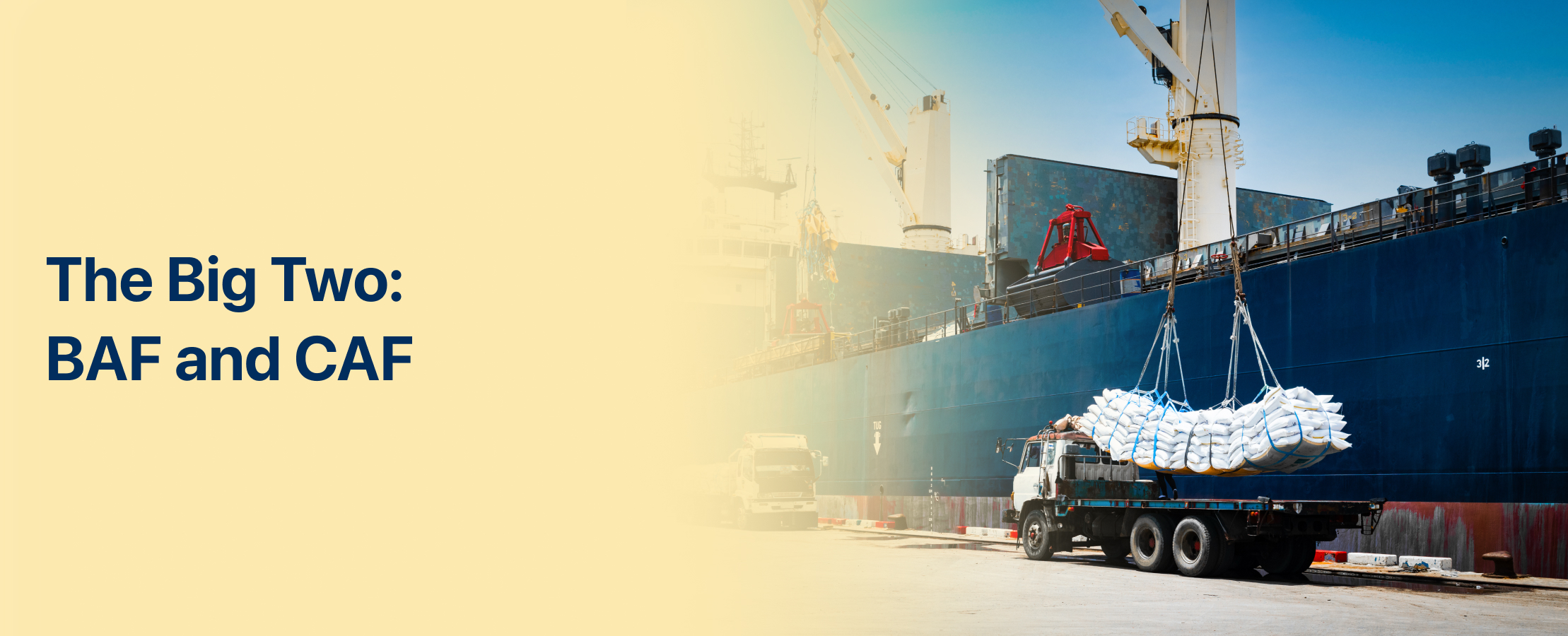
The Big Two_ BAF and CAF

These are the two most frequently seen and misunderstood surcharges, both used by shipping carriers to protect themselves against fluctuating operational costs.

BAF (Bunker Adjustment Factor)

  • What it is: BAF is a variable surcharge applied to compensate for global oil price fluctuations. The term "bunker" refers to the fuel used to operate the ships.
  • Why it's Charged: Fuel prices are one of the largest and most volatile components of shipping costs. BAF acts as a safeguard for carriers against sudden increases in the price of bunker fuel.
  • How it Works: BAF surcharges are generally calculated and issued each month or every quarter, rising when fuel prices soar and decreasing when they drop.

CAF (Currency Adjustment Factor)

  • What it is: CAF is a surcharge applied to mitigate losses or gains due to fluctuations in global currency exchange rates.
  • Why it's Charged: Freight rates are often quoted in U.S. dollars, but carriers incur operating costs (like port fees and labor) in various local currencies. If the billing currency (e.g., USD) weakens relative to the cost currencies, the carrier loses revenue.

How it Works: CAF is typically quoted as a percentage of the base ocean freight rate and is adjusted periodically to reflect market changes.

Other Common Surcharges You Need to Know

These are the two most frequently seen and misunderstood surcharges, both used by shipping carriers to protect themselves against fluctuating operational costs.

BAF (Bunker Adjustment Factor)

  • What it is: BAF is a variable surcharge applied to compensate for global oil price fluctuations. The term "bunker" refers to the fuel used to operate the ships.
  • Why it's Charged: Fuel prices are one of the largest and most volatile components of shipping costs. BAF acts as a safeguard for carriers against sudden increases in the price of bunker fuel.
  • How it Works: BAF surcharges are generally calculated and issued each month or every quarter, rising when fuel prices soar and decreasing when they drop.

CAF (Currency Adjustment Factor)

  • What it is: CAF is a surcharge applied to mitigate losses or gains due to fluctuations in global currency exchange rates.
  • Why it's Charged: Freight rates are often quoted in U.S. dollars, but carriers incur operating costs (like port fees and labor) in various local currencies. If the billing currency (e.g., USD) weakens relative to the cost currencies, the carrier loses revenue.

How it Works: CAF is typically quoted as a percentage of the base ocean freight rate and is adjusted periodically to reflect market changes.

These are the two most frequently seen and misunderstood surcharges, both used by shipping carriers to protect themselves against fluctuating operational costs.

BAF (Bunker Adjustment Factor)

  • What it is: BAF is a variable surcharge applied to compensate for global oil price fluctuations. The term "bunker" refers to the fuel used to operate the ships.
  • Why it's Charged: Fuel prices are one of the largest and most volatile components of shipping costs. BAF acts as a safeguard for carriers against sudden increases in the price of bunker fuel.
  • How it Works: BAF surcharges are generally calculated and issued each month or every quarter, rising when fuel prices soar and decreasing when they drop.

CAF (Currency Adjustment Factor)

  • What it is: CAF is a surcharge applied to mitigate losses or gains due to fluctuations in global currency exchange rates.
  • Why it's Charged: Freight rates are often quoted in U.S. dollars, but carriers incur operating costs (like port fees and labor) in various local currencies. If the billing currency (e.g., USD) weakens relative to the cost currencies, the carrier loses revenue.

How it Works: CAF is typically quoted as a percentage of the base ocean freight rate and is adjusted periodically to reflect market changes.